
E-Signature Trust Levels & Evidence
Every signature carries a trust level and a complete evidence record: who signed, what they meant, when, and how they were verified, with a unique ID that lets anyone confirm authenticity without logging in.
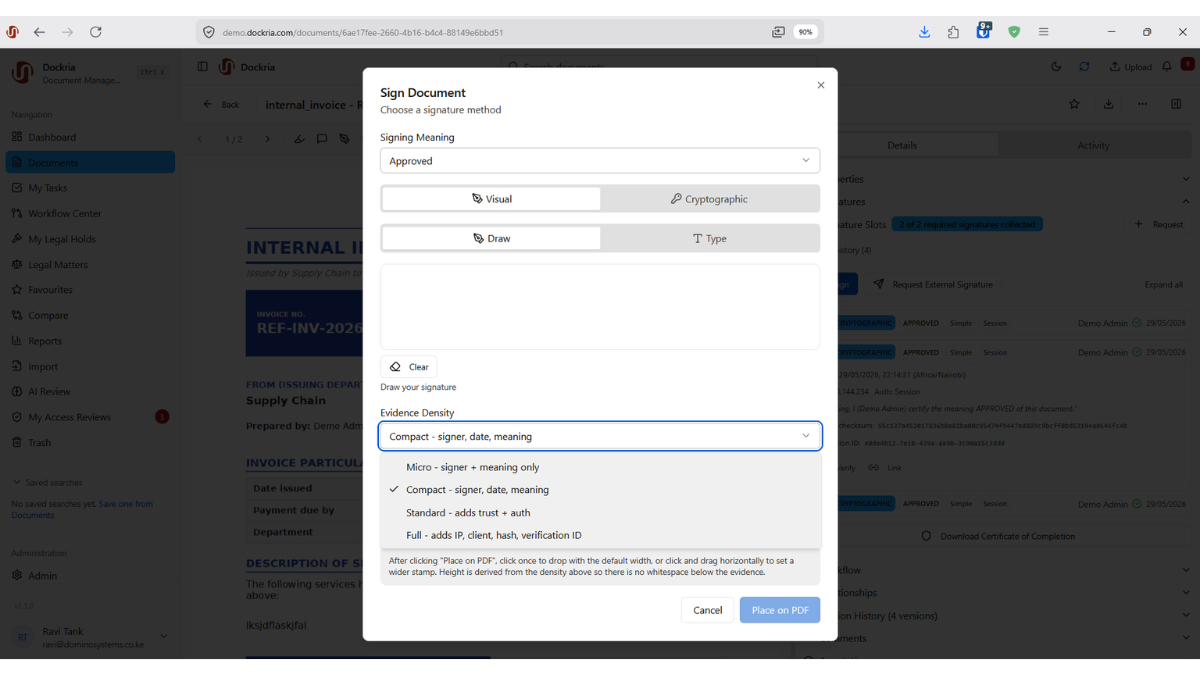
Collecting a signature is easy. Proving, years later, that a specific person knowingly signed a specific document is what actually matters when an agreement is challenged. Dockria grades every signature with a trust level and attaches a complete evidence record, so each signature carries its own proof of authenticity.
Signatures fall into clear trust tiers. A Simple signature is placed by any authenticated user. An Advanced signature requires more: the signer's authenticated session, a verified second-factor verification at the moment of signing, the document's version checksum, and the originating session details, together forming strong, independently checkable evidence of intent. A Qualified tier is reserved for the highest assurance level, designed to align with international electronic-signature frameworks.
Each completed signature prints a tamper-evident stamp onto the document showing the signer's name, the meaning of the signature (such as Approved, Reviewed, Authored, Acknowledged, or Witnessed), the trust level, the authentication method, and the date and time in the signer's own timezone. A unique Verification ID accompanies every signature.
Anyone (including a court, auditor, or counterparty) can use that Verification ID to confirm a signature's authenticity without needing to log in. The signature panel and workflow records show the same trust and authentication badges throughout, so the strength of every signature is transparent at a glance and provable on demand.
Key Benefits
Clear Trust Tiers
Every signature is graded Simple, Advanced, or Qualified, so the strength of each one is transparent and appropriate to the document.
Tamper-Evident Evidence Stamp
Each signature prints a stamp showing signer, intent, trust level, authentication method, and timestamp in the signer's timezone.
Second-Factor Verification
Higher trust levels require a verified second-factor at the moment of signing, producing strong evidence of deliberate intent.
Independent Verification ID
A unique ID lets anyone confirm a signature's authenticity without logging in, ideal for courts, auditors, and counterparties.
Signing Intent Captured
The meaning of each signature (Approved, Reviewed, Witnessed, and more) is recorded alongside it, removing ambiguity.
Designed to Meet Global Standards
The trust model is designed to align with internationally recognised electronic-signature frameworks.
Industry Use Cases
Firms capture court-ready signatures whose authenticity and intent can be proven independently if an agreement is disputed.
Banks apply advanced, second-factor-verified signatures to high-value approvals for defensible, auditable evidence.
Agencies record the meaning and trust level of every official sign-off for transparent, accountable decision-making.
Providers evidence consent and clinical approvals with verifiable signatures that withstand later scrutiny.
Related Features
See How This Feature Applies to Your Industry
Ready to see signature trust levels & evidence in action?
Schedule a personalised demo and discover how Dockria can transform your document management operations.
Request a Demo