
Electronic Signatures for Document Management
Ask people to sign documents and review the evidence recorded with each signature. One-time codes and digital seals depend on your setup. Whether a signature meets legal requirements depends on the document and applicable law.
Signature trust levels
- Simple
- Advanced
- Qualified — not issued by Dockria
These are trust-level categories, not proof of legal status. Check the signing method and legal requirements. Dockria does not issue Qualified signatures on its own.
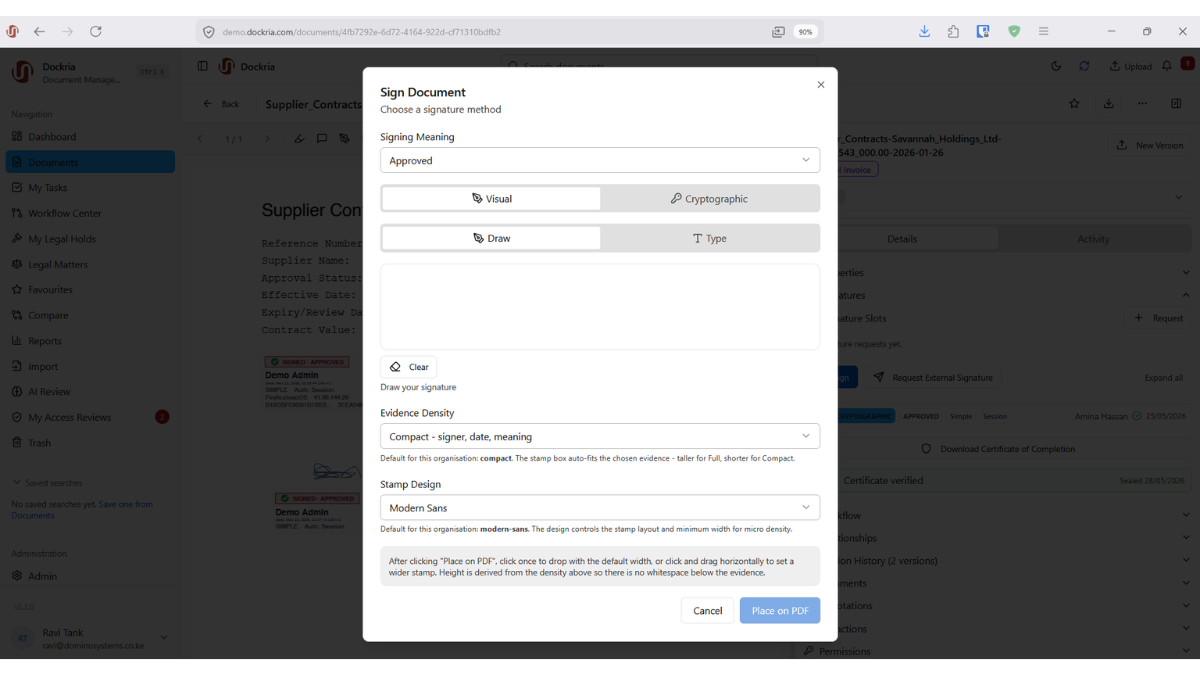
Existing interface image for orientation only. Framework names, status labels and signature stamps do not establish certification, legal conformity or a tested deployment. Use the qualified feature descriptions below.
How it works and what to check
Dockria supports drawn and typed electronic signatures, signature requests and external signing flows. Availability depends on permissions, assignments, configured signing rules and authentication; external requests and OTP require a configured delivery channel.
The documented cryptographic signing path uses self-issued seals. These can support document-integrity checks but do not establish independent certificate-authority trust, a signer's legal identity or guaranteed non-repudiation.
The Help Center Guide, Signature Evidence and Trust Levels (printed page 14), describes SIMPLE and ADVANCED evidence classifications. OTP-backed signing adds evidence such as authentication context and a document-version checksum. These are application classifications, not proof that a signature meets KICA or eIDAS legal requirements.
Dockria does not issue Qualified electronic signatures on its own. A reserved QUALIFIED schema value is not an operational qualified-provider service. The supplied October 2026 product assessment does not substantiate such a service; its core-source inspection was not independently repeated here and signing was not runtime-verified.
Evidence stamps record signing context, including the selected meaning (Approved, Reviewed, Authored, Acknowledged or Witnessed), authentication method, date and Verification ID. Cryptographic signatures additionally show the version checksum and public verification URL. Available verification records are supporting evidence, not a legal opinion or independent identity certification.
In Kenya, KICA section 83P addresses statutory signature requirements through an advanced electronic signature affixed as prescribed, subject to the Act's scope and applicable formalities. Evidence Act sections 78A and 106B address electronic evidence and its proof. A signature stamp does not guarantee admissibility, enforceability or a successful legal outcome.
Under EU eIDAS, Qualified signatures require a qualified certificate and qualified signature creation device; a self-issued seal or OTP alone does not establish that status. Assess the governing law, document type and signing process with legal advisers before relying on electronic signing for regulated or cross-border transactions.
Key Benefits
Evidence Classifications
Review SIMPLE or ADVANCED application evidence labels without treating them as legal certification. Qualified-signature support is not substantiated.
Recorded Signing Meaning
Record the selected signing meaning to help reviewers understand the signer's stated intent.
Verification Records
Use a Verification ID to inspect available records without logging in. This is not independent identity certification.
Optional OTP Evidence
Require a one-time code where configured, subject to authentication and delivery settings. OTP alone does not establish legal Advanced or Qualified status.
Visual Signatures and Self-Issued Seals
Use drawn or typed signatures and inspect self-issued cryptographic sealing evidence; independent certificate-authority trust is not established.
External Signature Requests
Request external signing through configured links and delivery channels, subject to permissions and signing rules.
Evidence Stamps
Review signing context and verification references. A stamp is supporting evidence, not a compliance certificate.
Remote Signing
Reduce physical document handling where electronic signing is appropriate for the transaction.
Industry Use Cases
Request signatures on suitable client documents after checking execution, witnessing and filing requirements.
Record signatures on permitted administrative documents; a signature alone does not establish informed clinical consent.
Collect signing evidence for suitable documents, subject to identity checks and applicable regulatory requirements.
Support signing of permitted correspondence and approvals after confirming agency rules and required assurance.
Related Features
See How This Feature Applies to Your Industry
Ready to see electronic signatures in action?
Schedule a personalised demo and discover how Dockria can transform your document management operations.
Request a Demo