
Records Management & Retention Software
From creation to destruction, manage every stage of a document's life with automated retention policies, archival rules, and secure disposition, all aligned with regulatory requirements.
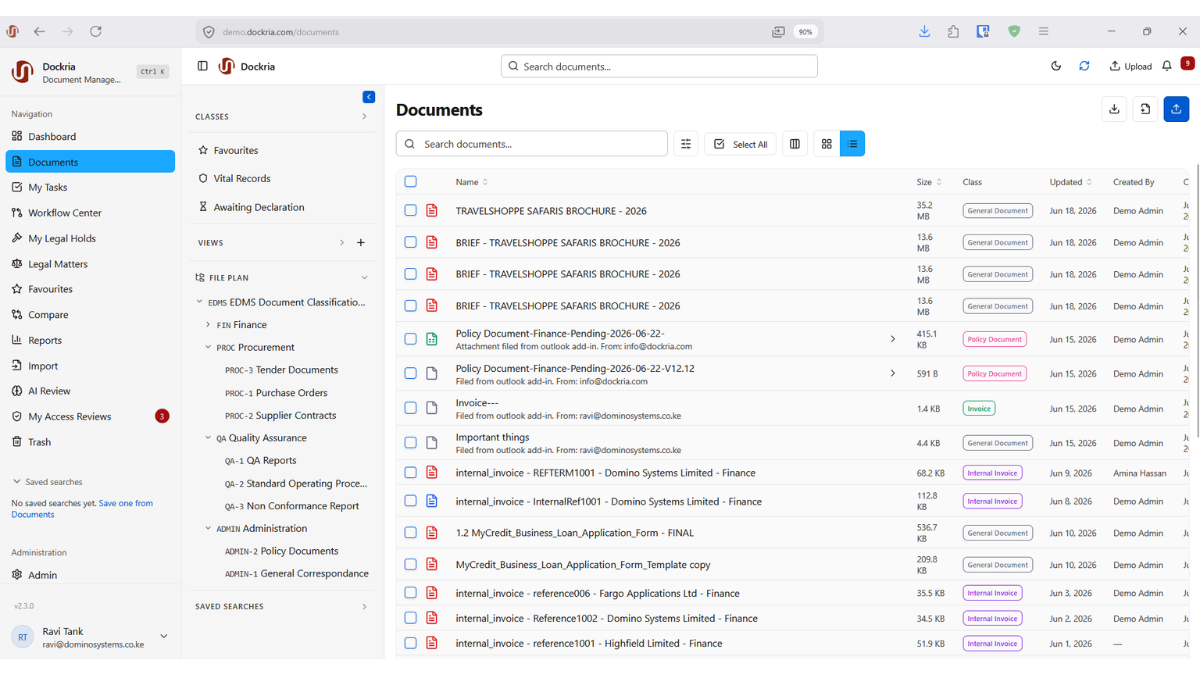
Documents have lifecycles. A contract is drafted, reviewed, signed, active, and eventually archived or destroyed. An invoice is received, approved, paid, retained for the legally required period, and then disposed of. Managing these lifecycles manually across thousands of documents is unsustainable and risky. Dockria automates the entire process.
Define retention policies by document class, department, or regulatory requirement. Dockria automatically tracks retention periods and triggers disposition actions when they expire. Documents can be automatically archived to long-term storage, flagged for manual review before destruction, or securely destroyed with logged confirmation, whatever your policy requires.
For organisations subject to the Kenya National Archives and Documentation Service guidelines, Dockria supports hierarchical file plans that align with official classification schemes. Build file plans with automated cutoff dates, transfer schedules, and disposition instructions that satisfy public sector record-keeping requirements.
Secure destruction is handled with the same rigour as storage. When a document's retention period expires and destruction is authorised, Dockria permanently removes the document and all its versions, metadata, and audit entries. A destruction certificate is generated and retained as proof that the disposition was carried out in accordance with your policies.
Dockria models the full record lifecycle in distinct, auditable stages (Draft, Active Record, Semi-Active, Archived, and Destroyed) so every document has a clear status at every moment of its life. Records officers can see exactly what is in active use, what is winding down, and what has been moved to long-term archive, with transitions between stages governed by the policies you define rather than by manual intervention.
Vital Records flagging lets you mark the documents your organisation cannot operate without (founding charters, master contracts, critical licences, irreplaceable registers) so they receive priority treatment in business continuity and disaster-recovery planning. Vital records are surfaced in dedicated dashboards and can be subject to stricter handling rules. The Disposition Log adds a final layer of defensibility, providing a tamper-evident certificate of destruction that lists exactly what was destroyed, when, under whose authority, and against which retention rule, the kind of record auditors and regulators expect to see when they ask how an old file was lawfully disposed of.
Key Benefits
Automated Retention
Define retention periods by document class and let the system automatically track, archive, and dispose of records on schedule.
Full Lifecycle Stages
Track every record through Draft, Active Record, Semi-Active, Archived, and Destroyed stages, with policy-driven transitions between each phase.
Vital Records Flagging
Mark mission-critical records so they are prioritised in business continuity and disaster-recovery planning, with dedicated dashboards for records officers.
Disposition Log
Every destruction produces a defensible certificate detailing what was destroyed, when, under whose authority, and against which retention rule.
File Plan Support
Build hierarchical file plans aligned with Kenya National Archives guidelines and public sector classification schemes.
Compliance Alignment
Retention policies can be mapped to specific regulatory requirements, ensuring every disposition is legally defensible.
Industry Use Cases
Public sector organisations implement official file plans with automated cutoff, transfer, and disposition aligned with KNA guidelines.
Financial institutions enforce 7-year retention rules for transaction records as required by Kenyan financial regulators.
Hospitals manage patient record retention periods, ensuring records are kept for the legally required duration and disposed of securely.
Law firms manage matter file retention, ensuring closed case files are retained for the required period and disposed of properly.
Related Features
See How This Feature Applies to Your Industry
Ready to see records management in action?
Schedule a personalised demo and discover how Dockria can transform your document management operations.
Request a Demo